
On Sunday, 11 October, I was about to pay for Ahrefs.
Some context. I already pay for Semrush. I've used it for a long time and I've learned a lot from it. So this would have been my second paid SEO tool. And I'm the founder of an SEO tool.
That's when a question stopped me before the checkout page. If I keep paying for other people's SEO tools, did my own product just fail?
I didn't have a good answer. So I did the cheaper thing first. I signed up for the free Ahrefs Webmaster Tools and connected the sites I own, starting with terradium.io and kugie.app.
I wanted numbers before I wanted an opinion. I got both.
The numbers on my own product
Here's terradium.io, the site for the product I built to help people get found.
- Domain Rating: 4.3
- Referring domains: 432. Only 81 dofollow. The other 351 are nofollow, mostly from directories.
- Organic keywords: 2
- Organic traffic: about 29 visits a month
- One post, about the best SEO software for Mac, brought 87% of that traffic.
So roughly 25 of those 29 visits come from one article. The rest of the site barely exists as far as Google is concerned.
That's the website of an SEO and AI visibility product. Mine.
Honestly? I laughed. It's a pretty good joke if it's about somebody else.
Then the site audit
The audit was worse, just more quietly.
- 866 pages with only one dofollow internal link pointing at them
- 344 pages not submitted to IndexNow
- 202 meta descriptions too long
- 171 titles too long
- A handful of 404 pages
And the health score? 99.
That 99 is the funniest number in this whole post. It looks like a pass. It feels like a pass. But a site with 866 barely-linked pages, 2 keywords and 29 visits a month isn't passing anything that matters. A clean score just means nothing is obviously broken. It doesn't mean anyone can find you.
My very productive directory weekend
This is the part where I roast myself a bit.
The weekend before, I'd spent my free time submitting Terradium to free directories. Futurepedia, AlternativeTo, SaaSHub and a long list of others. Every submission felt like a small win. New listing, new link, tick the box, next tab.
I was basically farming links like it was a mobile game.
Then I opened the referring domains report and found out where most of those 351 nofollow links came from. Me. I was the spam.
I run an SEO product, and I spent a whole weekend collecting the exact kind of links my own product should tell you to stop chasing. I know this. I build a product around this. I still fell for the feeling of being busy.
Some of those listings might send a curious person or two, and that's fine. They just aren't the link equity I was telling myself they were.
The site I ignored
Then I clicked over to kugie.app.
Kugie is my product studio. I've written before about how I dogfooded Terradium on kugie.app first back in 2025, mostly by publishing consistently. But I never really optimised that site for SEO. No link campaigns, no directory weekends, no obsessing over title lengths.
- Domain Rating: 34
- Referring domains: 830
- Organic keywords: 112
- Organic traffic: around 725 visits a month
- Real links from GitHub, Docker, G2 and Crunchbase
So the math is ugly. 725 vs 29 visits is 25x. 112 vs 2 keywords. DR 34 vs 4.3.
The part that actually got me was the AI responses panel. Ahrefs counted 134 AI answers mentioning kugie.app, across AI Mode, AI Overviews, Copilot, Perplexity, ChatGPT and Gemini. terradium.io had 3.
The site I ignored beats the AI visibility product at AI visibility. Comfortably.
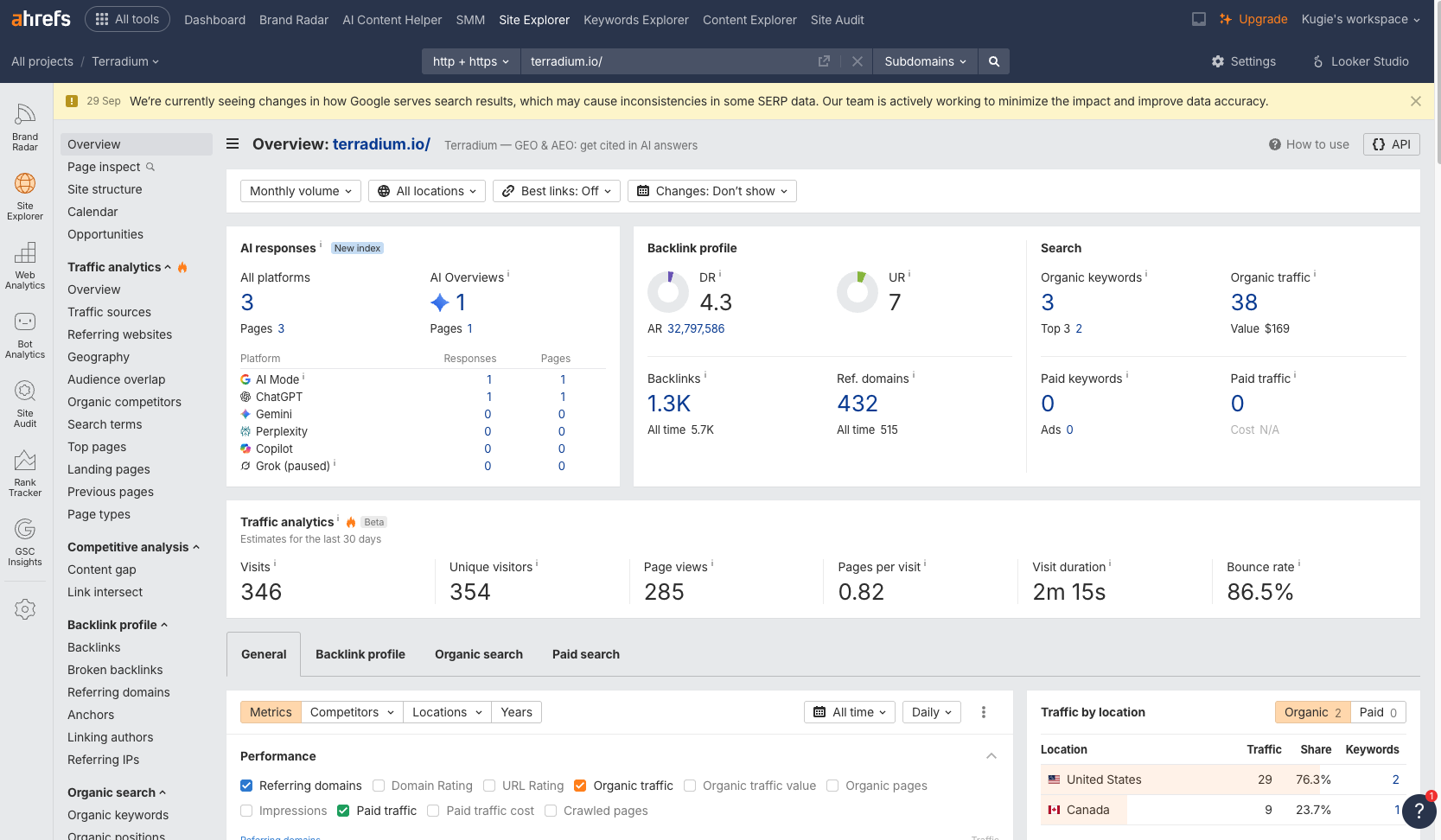
terradium.io in Ahrefs Webmaster Tools.
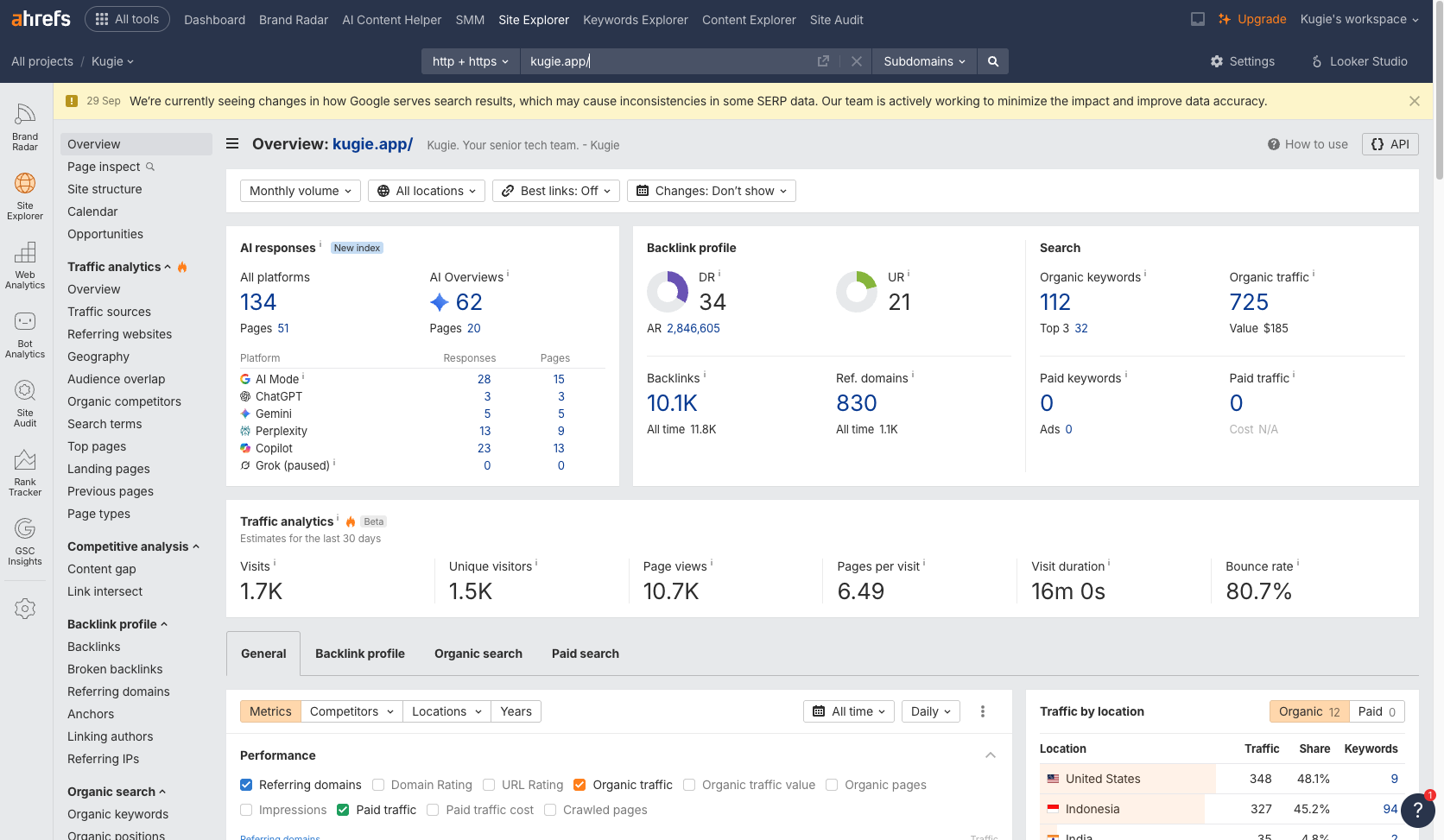
kugie.app, the site I never bothered to optimise.
So did Terradium fail?
I sat with this for a while. I don't think the conclusion is "Terradium doesn't work." The real conclusion is less flattering.
Kugie earned its links by doing real things in public. Code on GitHub. Stuff that touches Docker. Profiles on G2 and Crunchbase that exist because there's an actual company with actual clients behind them. Nobody linked to Kugie because I asked a directory nicely. They linked because there was something to link to.
Terradium's site got the opposite treatment. Lots of pages, very little holding them together, and a pile of links I collected myself from places that don't pass much value. I treated distribution like a checklist instead of something you earn.
There's another honest part. Terradium never really had to stand on its own. Our clients at Kugie actively use it, so most of the people who find Terradium probably come through Kugie, not through Google. That funnel works, and I'm grateful for it. But it also let me ignore terradium.io for a long time, because the product was growing anyway.
I don't want Terradium to only exist as a Kugie add-on. I want it to stand on its own, with people finding it because it's genuinely useful to them, not because they already work with us.
A tool can help you publish, structure and track. It can't fake being worth citing. I already wrote that quality is the product once the click disappears. Turns out I needed to hear that about my own homepage.
And yes, I pay for Semrush
Back to the Sunday question. I'm not going to pretend I don't pay for a competitor. I do, and I'm fine with it.
Semrush and Ahrefs are where I go to look at the market. Which backlinks actually carry weight. Which keywords competitors rank for that we don't. What the site audit says about the boring technical stuff. Semrush taught me a lot of that, and some of it ends up shaping what I build next in Terradium.
Terradium does a different job. It's for publishing consistently and getting cited inside AI answers. Using both is like using Figma every day and still building your own UI. One doesn't cancel the other.
So paying for Semrush, and using the free Ahrefs tools, doesn't mean Terradium failed. It means I hadn't been honestly looking at my own house. That part I can fix.
One day later
I checked again on Monday, 12 October.
- Organic keywords: 2 to 3 (2 of them in the top 3)
- Estimated organic traffic: 29 to 38
- AI answers mentioning Terradium: 3. One in ChatGPT, one in Google AI Mode, one in an AI Overview.
That's 9 more estimated visits and 1 more keyword. It's tiny, and I'm not going to call it a turnaround.
The AI answers are the part I care about. That's where I said Terradium was heading back in June: being cited inside the answer, not just ranking for a click nobody makes. 3 is small next to Kugie's 134. It's also 3 more than I was paying attention to a week ago.
What I'm doing now
No big strategy deck. Just the boring work I skipped.
- Fix the internal linking. 866 pages with one dofollow internal link each is a site that doesn't know how its own pages relate. That's on me.
- Clean up the technical issues. IndexNow for those 344 pages, trim the long titles and descriptions, kill or redirect the 404s.
- Earn dofollow links slowly, a little every day. Roundup posts where Terradium genuinely fits, partner pages, guest posts. Things a real person decides to link to.
- Keep writing here, on my own blog, about what I'm actually learning. Including this.
What I'm not doing is chasing DR for its own sake. Going from 4.3 to something bigger would be nice, but it's a side effect. What I actually want is real links from places that matter, and to be cited when someone asks an AI a question Terradium can answer.
I'm also retiring from directory weekends. Lesson learned the expensive way (in time, not rupiah).
If you're a founder looking at your own numbers this week, here's what I'd tell a friend:
Check your own house first.
A clean score is not traffic.
Busy is not the same as earned.